阅读视图

Suspect Detained After Shots Fired at White House Correspondents' Dinner
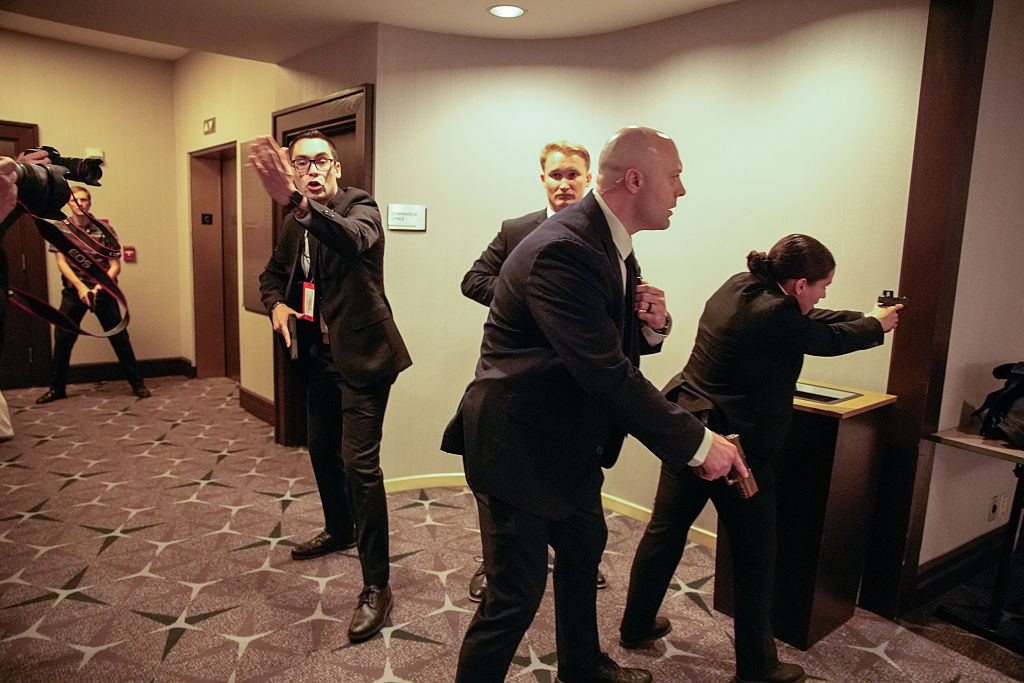
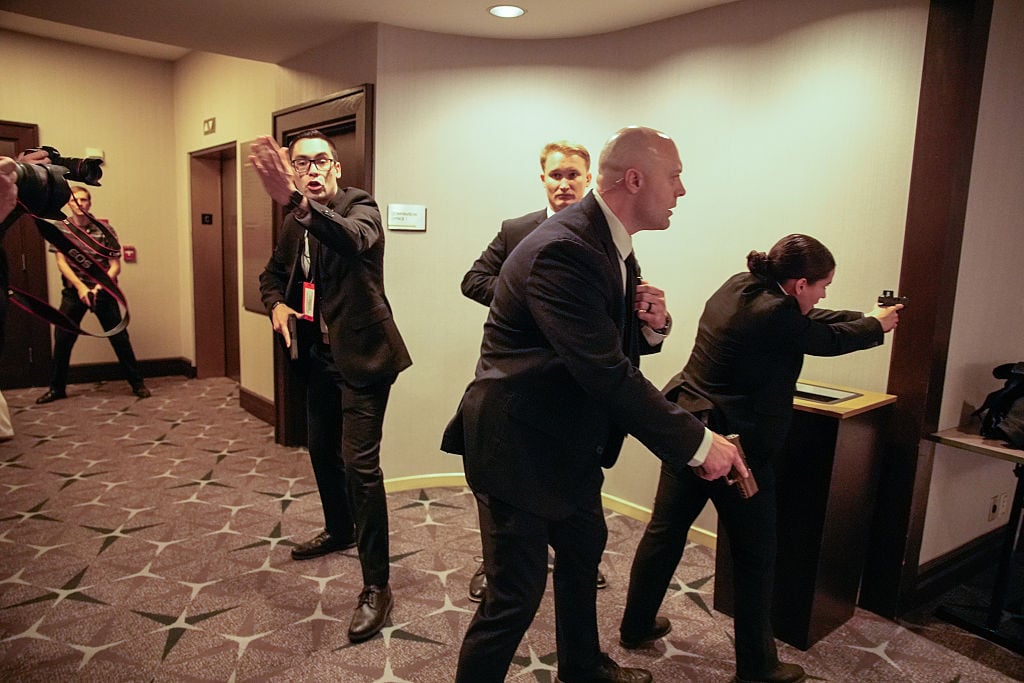
Law enforcement officers respond to reports of a shooting during the White House Correspondents' Association (WHCA) dinner in Washington, DC, US on Saturday, April 25, 2026. President Donald Trump and Vice President JD Vance were evacuated from the White House Correspondents' Association dinner event in Washington Saturday following a security incident at the venue. —Yuri Gripas—Abaca/Bloomberg via Getty Images

A gunman opened fire while trying to force entry to the White House Correspondents’ Association (WHCA) dinner on Saturday evening, forcing President Donald Trump and members of his cabinet to be rushed off the stage by Secret Service.

Video from the ballroom at the Washington Hilton in Washington, D.C., showed Secret Service agents running onto the stage before escorting the president and Vice President J.D. Vance away. Hundreds of attendees took cover under their tables as gunshots rang out and a voice could be heard shouting, "Get down!"

The gunman was identified as Cole Tomas Allen, 31, of Torrance, California, by two law enforcement officials to The Associated Press. The FBI said the suspect was detained by law enforcement.

Speaking at a hastily called press conference at the White House after the shooting, Trump said that a law enforcement officer was shot by a "lone wolf whack job" who tried to storm the room where the event was taking place, but the officer was saved by a bulletproof vest and was in "great shape."

Read more: Journalists Toast Freedom of the Press at Dinner

"In light of this evening's events, I ask that all Americans recommit with their hearts to resolving our differences peacefully," Trump said.

The president said he had ordered the release of CCTV footage of the incident, which occurred near a security screening area outside the room where the event was held. The video, which he posted on Truth Social, showed a man running through the security check area before several law enforcement officers opened fire on him.

The Washington Metropolitan Police Department said the suspect charged a Secret Service checkpoint at 8.36 p.m. carrying a "shotgun, a handgun and multiple knives," and that law enforcement "exchanged fire" with the gunman.

What happened at the White House Correspondents' Dinner?

The WHCA dinner is an annual event for White House staff and the press, typically featuring comedy and a satirical speech from the president.

Most people were inside the ballroom when the shooting took place, but CNN’s Wolf Blitzer said he was a few feet away when he witnessed a gunman fire a "very serious weapon" at least six times. He told CNN in an interview that the shooter "seemed to have gone through the metal detector, but he had a weapon and he was firing a weapon."

A TIME journalist attending the event said Secret Service agents ran through the crowd to escort Trump Administration cabinet members to safety immediately after several loud noises were heard on the ballroom floor.

Trump said on Truth Social shortly after the incident that he wanted to continue with the event, but that law enforcement had requested that he leave the premises, "consistent with protocol."

"The First Lady, plus the Vice President, and all Cabinet members, are in perfect condition," he wrote, adding that the event would be rescheduled within 30 days.

Speaking to reporters at the White House later, Trump was asked why he had been targeted for assassination numerous times—including a near miss at a rally in Butler, Pennsylvania, during the 2024 presidential campaign.

"I've studied assassinations, and I must tell you the most impactful people, the people that do the most—you take a look at the people, Abraham Lincoln, I mean, you go through the people that have gone through this, where they got them, but the people that do the most, the people that make the biggest impact, they're the ones that they go after," he said.

This is a developing story and will be updated.
© Yuri Gripas—Abaca/Bloomberg via Getty Images
Law enforcement officers respond to reports of a shooting during the White House Correspondents' Association (WHCA) dinner in Washington, DC, US on Saturday, April 25, 2026. President Donald Trump and Vice President JD Vance were evacuated from the White House Correspondents' Association dinner event in Washington Saturday following a security incident at the venue.
  •  

Trump Cancels Iran Peace Talks at Last Minute: 'We Have All the Cards'

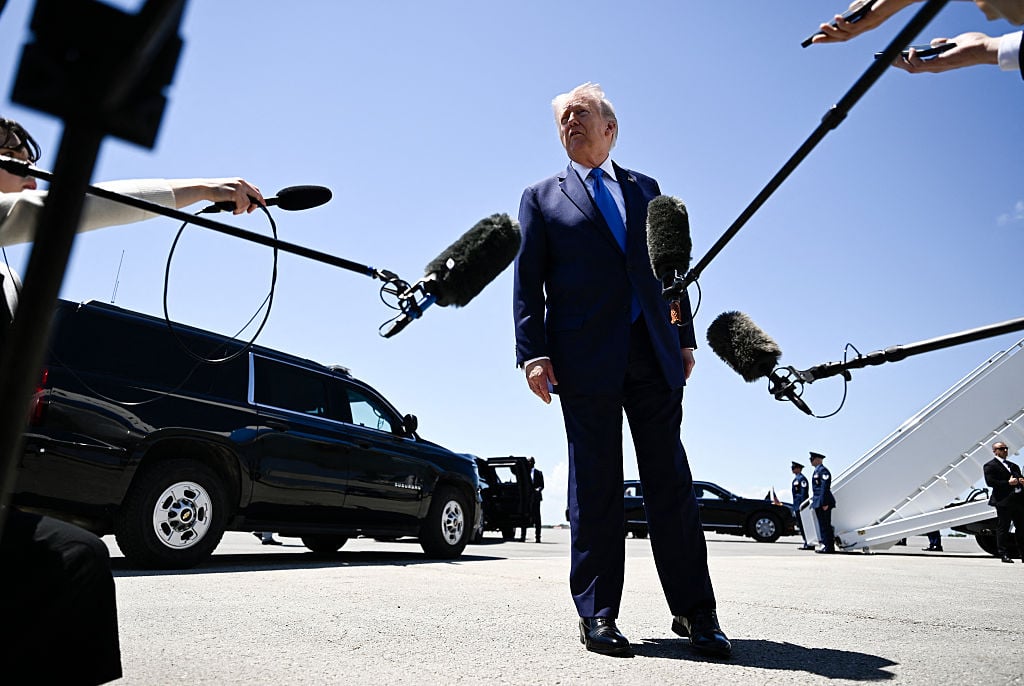
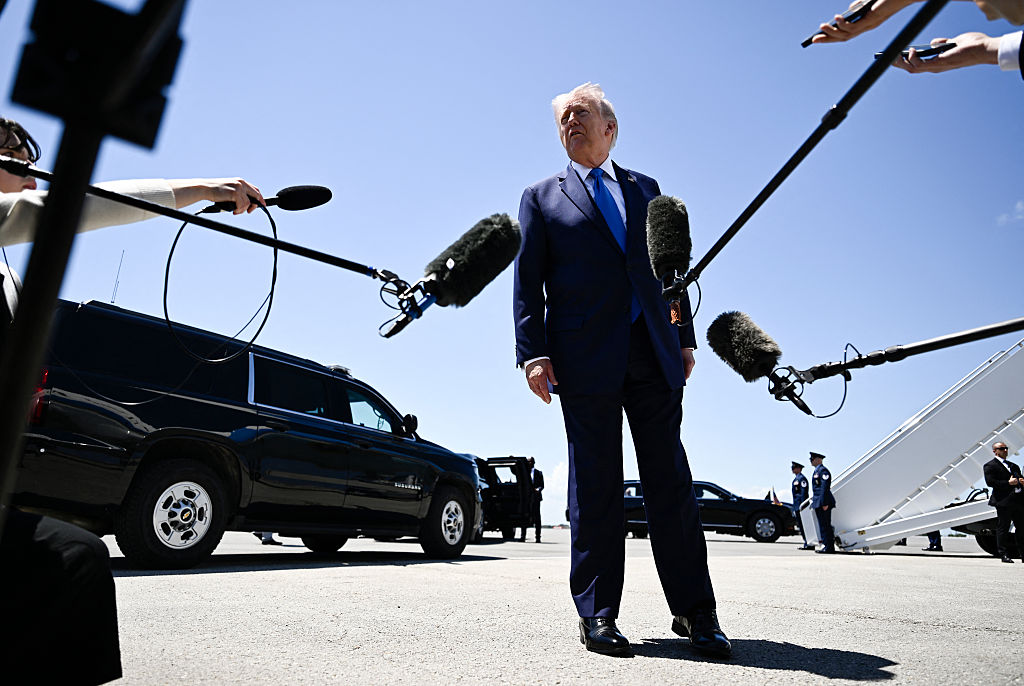
US President Donald Trump speaks to journalists before boarding Air Force One at Palm Beach International Airport in West Palm Beach, Florida, on April 25, 2026. President Trump is on his way back to Washington where he will be attending the White House Correspondents' dinner for the first time while in office —Kent NISHIMURA—AFP

President Donald Trump abruptly canceled plans for U.S. envoys to travel to Pakistan for peace talks with Iran on Saturday, throwing the latest round of negotiations aimed at ending the war in doubt. 

Special envoy Steve Witkoff and Jared Kushner, the president’s son-in-law, were due to travel to Islamabad for talks with Iranian leaders later Saturday, but Trump called them off at the last minute, blaming “infighting” among Iran’s leadership.

“Too much time wasted on traveling, too much work!” he wrote on Truth Social. “Besides which, there is tremendous infighting and confusion within their ‘leadership.’ Nobody knows who is in charge, including them.”

“Also, we have all the cards,” he wrote.

Read more: Tehran Says 'No Decision Yet' on Joining Peace Talks as Iranian President Flags Distrust of Washington

He reiterated that point when speaking to reporters in West Palm Beach on Saturday before boarding Air Force One.

“We have all the cards. We’re not going to spend 15 hours in airplanes all the time, going back and forth, to be given a document that was not good enough,” he said, adding that Iran could just “call” the U.S.

The news comes a day after White House press secretary Karoline Leavitt told Fox News that the president directed the duo to fly to Pakistan for in-person talks as the conflict nears two months, and a tentative cease-fire was extended by Trump this past week. Leavitt said there had been some progress with the Iranians in recent days and the Administration had been hoping for further movement after Witkoff and Kushner’s meetings.

But hours before they were due to depart, Iranian Foreign Minister Abbas Araghchi left Islamabad for Oman after negotiating for almost a full day with Pakistani officials, who have become unlikely peace brokers between the two sides in the war.

He said in a post on X after leaving that Iran has  “yet to see if the U.S. is truly serious about diplomacy.”

Trump’s cancellation of the trip is the second time in a week he has called off a planned trip by U.S. officials. Vice President J.D. Vance was expected to travel to Islamabad earlier this week, but the trip was canceled at the last minute.    

Meanwhile, Israel has continued its assault on southern Lebanon, intensifying on Saturday with two raids in the Nabatieh district and killing four people.

Israeli Prime Minister Benjamin Netanyahu’s office said in a statement that he had instructed the military to carry out “powerful strikes” against Hezbollah targets in Lebanon, despite a cease-fire being in place.

The Strait of Hormuz is still closed

Iran’s control of the Strait of Hormuz has become central to the negotiations aimed at ending the war. Iran has effectively closed the Strait, through which one-fifth of the world’s oil flowed before the fighting began, allowing only its allies to traverse the vital waterway, and others if they paid a toll. The U.S. has since imposed its own blockade on all traffic in an attempt to pressure Iran to open the Strait.

Shipping data on Friday shows that just five ships sailed through the Strait, a far cry from the more than 130 ships that would pass through before the war began on Feb. 28. The Strait’s closure has caused a global energy crisis and a wave of fuel rationing.

Oil prices have risen by more than 11% in the past week as diplomacy has failed to end the conflict, and Brent crude futures rose to more than $105 a barrel in early trading on Friday.

© Kent NISHIMURA—AFP

US President Donald Trump speaks to journalists before boarding Air Force One at Palm Beach International Airport in West Palm Beach, Florida, on April 25, 2026. President Trump is on his way back to Washington where he will be attending the White House Correspondents' dinner for the first time while in office
  •  

U.S. Soldier Involved in Maduro Capture Arrested and Charged With Insider Trading on Polymarket

—Davide Bonaldo—SOPA Images/LightRocket/Getty Images

A U.S. special forces soldier involved in the U.S. capture of Venezuelan leader Nicolás Maduro has been charged with using classified information about the military operation to make more than $400,000 in profit through the online betting market, Polymarket, federal authorities announced Thursday.

In the indictment unsealed in Manhattan federal court, federal prosecutors allege that Gannon Ken Van Dyke, a Master Sergeant with the U.S. Army Special Forces, used sensitive classified information to make multiple bets totaling almost $34,000 on Polymarket, a popular prediction market platform, in the lead-up to the operation on Jan. 3.

Van Dyke was arrested and has been charged with unlawful use of confidential government information for personal gain, theft of nonpublic government information, commodities fraud, wire fraud, and making an unlawful monetary transaction. If convicted, he could face decades in prison.

Who is Van Dyke?

Several unnamed officials told CBS News that Van Dyke, 38, of Fayetteville, N.C., was a communications specialist supporting Joint Special Operations Command, a task force that oversees tier-one special mission units. 

According to the indictment, Van Dyke has been on active duty since 2008, and was stationed at the time in the Fort Bragg military complex in North Carolina, where the Joint Special Operations Command is housed.

The indictment said that from around Dec. 8, 2025 to Jan. 5, 2026, Van Dyke was involved in the planning and execution of Maduro’s capture and had access to sensitive, non-public, classified information. 

The extent of Van Dyke’s involvement isn’t clear, though the indictment said that after U.S. forces carried out Maduro’s capture, a photograph of Van Dyke was taken and uploaded to his Google account. The photograph, according to the indictment, depicts him “on what appears to be the deck of a ship at sea, at sunrise wearing U.S. military fatigues, and carrying a rifle, standing alongside three other individuals wearing U.S. military fatigues.”

The federal prosecutor’s office in New York added that Van Dyke had signed nondisclosure agreements, in which he promised to “never divulge, publish, or reveal by writing, words, conduct, or otherwise . . . any classified or sensitive information” relating to military operations.

What is he accused of doing?

On or around Dec. 26, 2025, Van Dyke allegedly created an account on Polymarket, where users can bet on the likelihood of an event happening by buying “yes” or “no” shares. The President’s son, Donald Trump Jr., signed on as an adviser to Polymarket as well as Kalshi, another prediction market platform, last year.

Between the next day and Jan. 2, 2026, Van Dyke purportedly traded on Maduro- and Venezuela-related contracts 13 times, purchasing approximately $33,934 in “yes” shares.

In a parallel complaint filed against Van Dyke, the Commodity Futures Trading Commission, which regulates prediction markets, alleged that Van Dyke had funded his cryptocurrency exchange with around $35,000 from his personal bank account on Dec. 26, 2025, about a week before the Venezuela operation. 

Trump announced the operation in the early hours of Jan. 3, and Van Dyke won his wagers and allegedly sold his positions for profit. On the same day, he withdrew the proceeds from his Polymarket account and transferred them into a foreign cryptocurrency vault and then a brokerage account.

Reports of suspected insider trading about the Maduro operation on Polymarket emerged afterward, particularly focused on a user who made about $400,000 in profit. 

The indictment added that Van Dyke “took steps to conceal his identity as the trader in the Maduro- and Venezuela-related markets” after, including by asking Polymarket to delete his account and changing the email address registered to his cryptocurrency exchange account to one that was not subscribed under his name.

U.S. Attorney for the Southern District of New York Jay Clayton said in the announcement of Van Dyke’s indictment that prediction markets “are not a haven for using misappropriated confidential or classified information for personal gain” and that what Van Dyke did was “clear insider trading and is illegal under federal law.”

Polymarket, in a statement posted on X on Thursday, said that when they identified a user trading on classified government information, they referred it to the Justice Department and cooperated with the investigation. “Insider trading has no place on Polymarket,” the statement read. “Today’s arrest is proof the system works.”

How officials have reacted

Insider profiteering off prediction market platforms has become a growing concern in Washington, and some lawmakers are questioning how to police the platforms amid suspicious activity. Earlier in April, the Associated Press reported that several new Polymarket accounts made very specific, well-timed bets on a U.S.-Iran ceasefire on April 7; those accounts reaped hundreds of thousands of dollars in profit. The White House subsequently warned staff against using confidential information to place trades and bets. Kalshi also recently fined and suspended three congressional candidates whom the company claimed bet on the results of their own elections.

President Donald Trump was asked about the soldier on Thursday, as well as if he’s concerned about federal employees betting on prediction markets, but he said he didn’t know about the specific case and would “look into it” but wondered if the soldier had bet for or against the success of the operation.

“That’s like Pete Rose betting on his own team,” the President said, referring to the late baseball manager and player who was banned for life after he was caught having bet on the sport and his own team, the Cincinnati Reds.

As for suspected insider trading on the outcomes of the war in Iran, Trump said, “Well, the whole world unfortunately has become somewhat of a casino. And you look at what’s going on all over the world, in Europe and every place, they’re doing these betting things. I was never much in favor of it. I don’t like it conceptually, but it is what it is.”

© Davide Bonaldo—SOPA Images/LightRocket/Getty Images

  •